Landscape Architecture’s Identity Crisis


A recent review of our blog recently sparked a thought concerning landscape architecture. Most people do not really know what landscape architects are. This is a common topic of discussion in the profession, with seemingly monthly discourses in the professional magazine and lengthy manifestos, like that done at Iowa State- An Apocalyptic Manifesto, which laments the profession’s complacency:

“At the start of the 21st Century, landscape architecture is a troubled profession, more distinguished by what it lacks than the qualities that it actually possesses. It has no historiography, no formal theory, no definition, direction, or focus. A vast schism currently existing between its academics and professional practitioners. In universities across the nation, researchers poach methodologies from other, more vibrant disciplines. Meanwhile, in professional offices, designers yoked to the bottom line crank out pedestrian design.”

Of particular interest to me are the public’s perception of landscape architecture and landscape architecture’s relation to the construction industry. Ask your average person on the street to name an architect and a minimum you will get the iconic Frank Lloyd Wright. Likely modern names of Pei, Geary, and others will follow. Pose the same question with landscape architects, and any response would probably be an exception rather than the rule. Should landscape architects be as recognized as architects? Ask the same question of notables, concerning other design disciplines such as engineering, and you are unlikely to draw a response either (The Spanish architect and engineer Calatrava jumps to my mind).

From our perspective in residential landscape design and construction, a strengthening of the relationship between landscape architect and builder is something that could help the profession as well. Design theory is one important element, but equal focus on construction methodology and cost could enhance and improve the public sector practice of the profession.

For More:
Manifestos from the Pruned Blog
A definition from Gardenvisit
ASLA definition of the Profession
Wikipedia definitions and professional associations
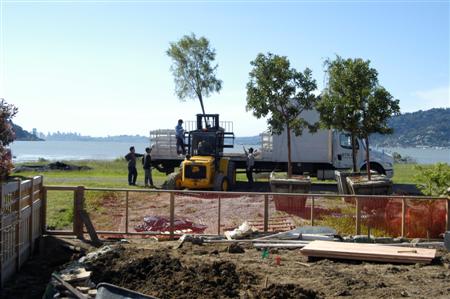
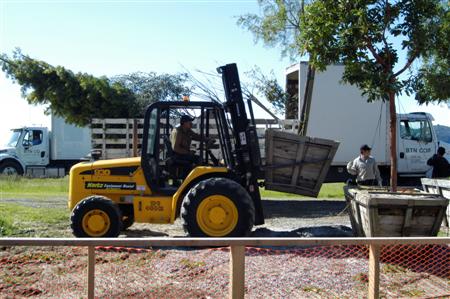
Progress Images- Moving Box Trees

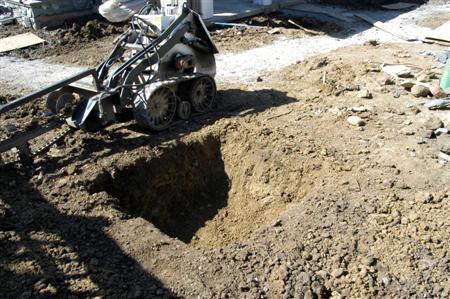
We are taking advantage of the dry weather to bring in some box trees on a
current project in Tiburon. These 36″ & 48″ box trees can be a bit of a
challenge to move; we are using a 4 wheel drive construction forklift with a
6000 pound lifting capacity. 48″ box trees can weigh between 3000-4000 pounds a
piece making this type of equipment a must.

btree3.JPG

btree1.JPG

btree2.JPG


A

An End to the Rain

Well it looks like we finally have a break from the rain, at least for this week. So far year to date here are the precipitation numbers from the National Weather Service (as reported from the Civic Center in San Rafael):

Jan: 4.97
Feb: 2.74
Mar 11.41
Apr: 8.40

This totals 27.5 inches of rain to date, last year we had half this amount (14 inches).

Last year was also a wet year with rain into June:
Jan: 0.00
Feb: 5.02
Mar: 7.22
Apr: 2.07
May: 3.35
Jun: 0.53

Hopefully we do not have a repeat of last year’s May. All of this precipitation affects our landscape projects, resulting in muddy conditions and slowed time tables.

For More:
Find rain data from the County of Marin Website


More on Biking Commuters

Here is a follow up to my post last week concerning biking to work and commuting bikers. I wrote an email inquiry to the Marin Bicycle Coalition, who were very responsive in answering:

“It depends which roads you are talking about. The County of Marin doesn’t do “bike counts” to assess the number of people cycling. So if it’s county roads (such as sections of Alameda del Prado or Atherton) then the data doesn’t exist. Yet. However, that will change when the Non-Motorized Pilot Program starts. The County will have to do before and after bike counts, though it’s worth noting that they will probably only do counts on streets relevant to the bike projects being built at a part of that program.”

So as part of the new funding for the pilot programs counts will happen in effected areas. I found from MBC, some data from the US Census Bureau, which confirms my suspicion, virtually nobody (nationally .4%) bikes to work. This may be why the county doesn’t count bikers currently.

Biking has actually gone down quite a bit over time, as well as alternative means of transportation to work.

In 1960:
10% Walked to work
12% Took public transportation
64% Drove to Work

By 1990
4% Walked to work (down 60%)
5.3% Took public transportation (down 56%)
86% Drove to Work (up 35%)
-73% of those who drove, drove alone

Means of Transportation to Work for the U.S.: 1990 Census [I couldn’t find 2000 information]

|Means of Transportation to Work | Number Percent |

|Workers 16 years and over………. | 115,070,274 100.0 |

| Car, truck, or van…………… | 99,592,932 86.5 |
| Drove alone……………….. | 84,215,298 73.2 |
| Carpooled…………………. | 15,377,634 13.4 |
| Public transportation………… | 6,069,589 5.3 |
| Bus or trolley bus…………. | 3,445,000 3.0 |
| Streetcar or trolley car……. | 78,130 0.1 |
| Subway or elevated…………. | 1,755,476 1.5 |
| Railroad………………….. | 574,052 0.5 |
| Ferryboat 1/………………. | 37,497 0.0 |
| Taxicab…………………… | 179,434 0.2 |
| Motorcycle………………….. | 237,404 0.2 |
| Bicycle…………………….. | 466,856 0.4 |
| Walked only…………………. | 4,488,886 3.9 |
| Other means…………………. | 808,582 0.7 |
| Worked at home………………. | 3,406,025 3.0 |

1/ This category was included in “Other means” prior to 1990.


When It’s All about Price

I stumbled up a great post on a Gardenweb forum by a garden center owner. A young couple asked him why his plants cost $25, when Home Depot only charged $10. He explained in his posting that he was lucky to make 7% on his $25, but rather than explain rising gas, water, and overhead cost, he simply replied that if cost was their only consideration you should shop at Home Depot (garden center employees could be working in the lumber department in the winter and often have little plant knowledge).

Pricing is often a sensitive subject with clients. But, if consumers think that their local garden center (hardware store, etc.) can compete with one of the worlds largest corporations on a price basis, they have little or no understanding of the realities of the marketplace.

Why does a beer at a restaurant cost $4 when you could go to the supermarket and buy a six pack for $7? Because, you are paying for an experience of being in a full service restaurant, not just the beer.

We aren’t the cheapest in our market segment either, but we sell more than landscaping, we sell a process and customer service along with our product. We tell potential clients the same thing as the nursery owner, if price is your only consideration, we are not going to be the right fit for your needs.


Compliments from the Mail Bag

Below is an email I received from a reader of our blog & website. I always enjoy emails like this one!
In the afternoon, we logged on to your website … and I must say that both my husband and I were SO impressed with your website. It is just amazing!

The photos are absolutely wonderful (and we learned that you took all of them as well — more compliments!), and the articles, information, and links are so helpful. As I have studied the Japanese Tea Ceremony and appreciate all things Japanese, I particularly enjoyed the wonderful photos of the Japanese gardens. Beautifully done!

We have marked your site as a “favorite” and will certainly return again and again. An extraordinary job!


The Katrina Cottage


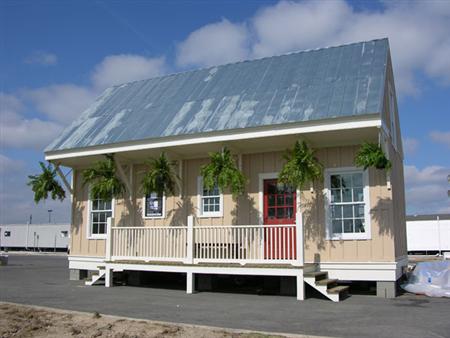
There was an article in Slate last week highlighting the ingenious Katrina Cottage, a low cost alternative to the FEMA trailer, for victims of hurricanes Katrina and Rita. The cost of construction of the Cottages (there are several designs) is the same or less than the trailers. In addition, they are designed to better resist future flooding and hurricanes (walls are constructed of a concrete board to prevent mold and mildew). FEMA, however, is a hard sell so far. These cottages make sense, they work as a longer term solution to the problem and provide a more comfortable living environment.

katcotsm.jpg
Image courtesy Slate

For More:
Inhabitat Article
Cusato Cottages- Manufacturers of one of the designs
Business Week Article